Altair PhysicsAI · AI Physics Predictions
Altair PhysicsAI Deep Learning for Simulation
Train geometric deep learning models on the simulations you have already run, then predict new designs directly on CAD or mesh in seconds and save full solver runs for the best candidates. Now Simcenter PhysicsAI, licensed and supported by TrueInsight.
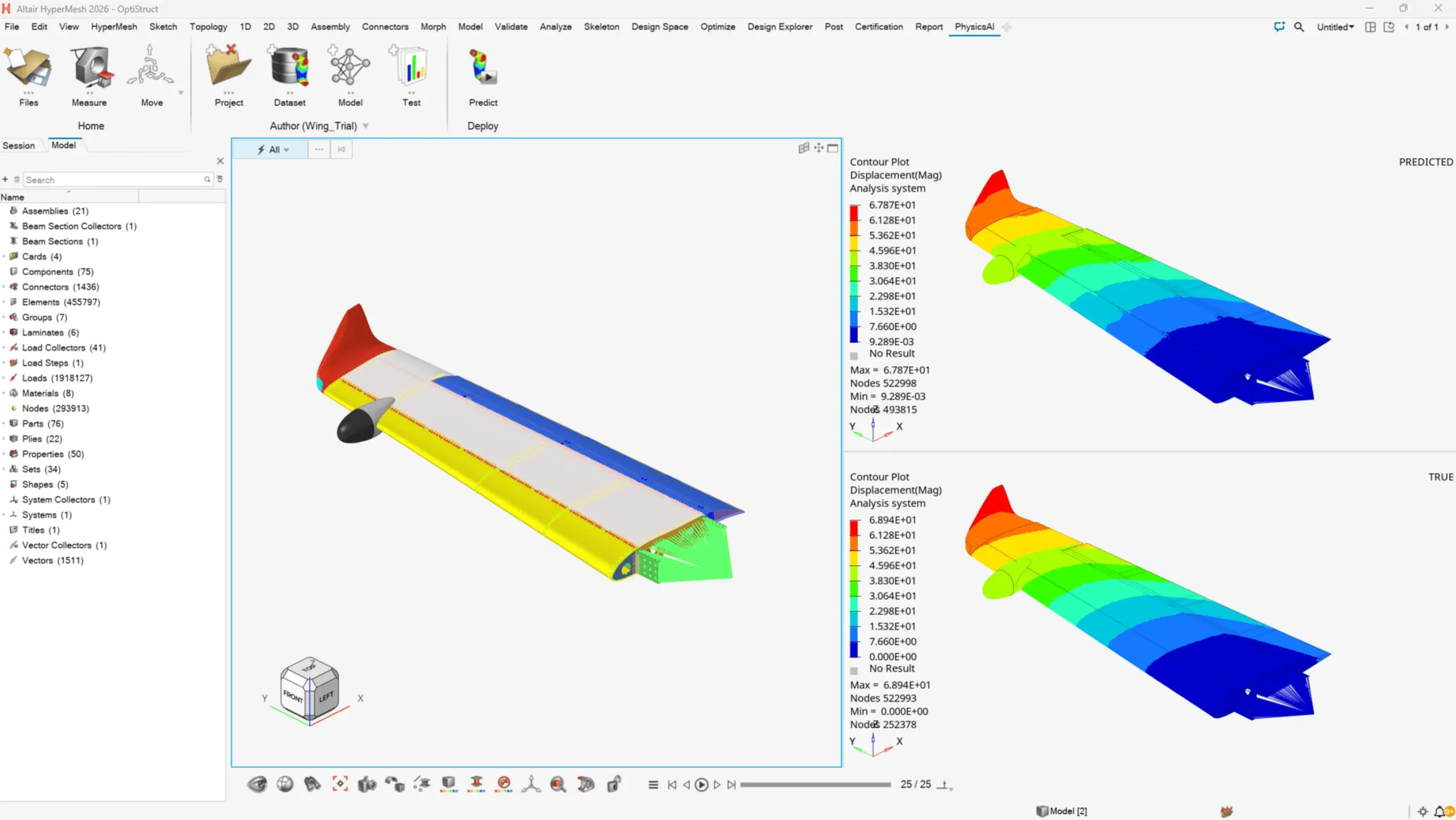 PhysicsAI · Prediction vs Solver
Overview
What Is Altair PhysicsAI?
Altair PhysicsAI is an AI-powered simulation technology that uses geometric deep learning to generate fast physics predictions from existing simulation data. It learns from past studies across different designs, components and programs, then predicts results for new concepts directly on CAD or mesh geometry, without a full solver run.
PhysicsAI works inside Altair HyperWorks tools such as HyperMesh, as well as SimLab and Altair Inspire. With the June 2026 Simcenter release, former Altair products joined the Siemens Simcenter family, so PhysicsAI now also carries the Simcenter PhysicsAI name, and Siemens offers it as an add-on in Simcenter STAR-CCM+. TrueInsight licenses and supports it under either name.
- Predictions Directly on CAD or Mesh Geometry
- Trained on Your Own Historical Simulation Data
- Structural, Thermal, Fluid and Electromagnetic Physics
- Built Into HyperMesh, SimLab and Inspire
 PhysicsAI · Dataset Curation
Key Capabilities
AI Predictions Built on Your Engineering Data
PhysicsAI turns the simulation results your team already has into predictive models, so every past study helps evaluate the next design instead of sitting in an archive.
Geometric Deep Learning on CAD and Mesh
Models train directly on mesh and CAD geometry with no manual feature engineering, so engineers can explore unconventional, non-parametric designs across different shapes and topologies.
Learns From Your Existing Simulation Data
Reuse validated results from past designs, components and programs. Siemens describes PhysicsAI as solver-agnostic: native CAE models and legacy data work without reformatting or conversion.
Multiple Physics Domains
Predict structural, thermal, fluid and electromagnetic results, from single performance values to full 3D field distributions.
Built-In Similarity Assessment
A geometric similarity score shows how close a new design is to the training data and flags out-of-distribution designs that need a full-fidelity simulation.
Multi-Objective Design Exploration
Evaluate thousands of design variations in real time, generate Pareto frontiers and find the best trade-offs between competing objectives.
Integrated With Your CAE Tools
Train, test and predict with no-code workflows inside HyperMesh, SimLab and Inspire, or in Design Manager in Simcenter STAR-CCM+.
How It Works
From Historical Data to Real-Time Predictions
PhysicsAI starts from result files you already have. Build training and test datasets from past simulations, train a model on the result you care about, such as displacement, temperature or pressure, and test it against results it has not seen before you rely on it.
Training can run on a local workstation or in the cloud, and Siemens notes it can also run on secure on-premises servers, so proprietary design data stays in an environment you control. A GPU is recommended for faster training but not required. Once trained, the model predicts new designs in real time, and the best candidates go back to the solver for validation.
- Build Training and Test Datasets From Past Results
- Train Locally or in the Cloud
- Test Against Known Results Before You Trust a Model
- Predict New Designs, Then Validate the Best With the Solver
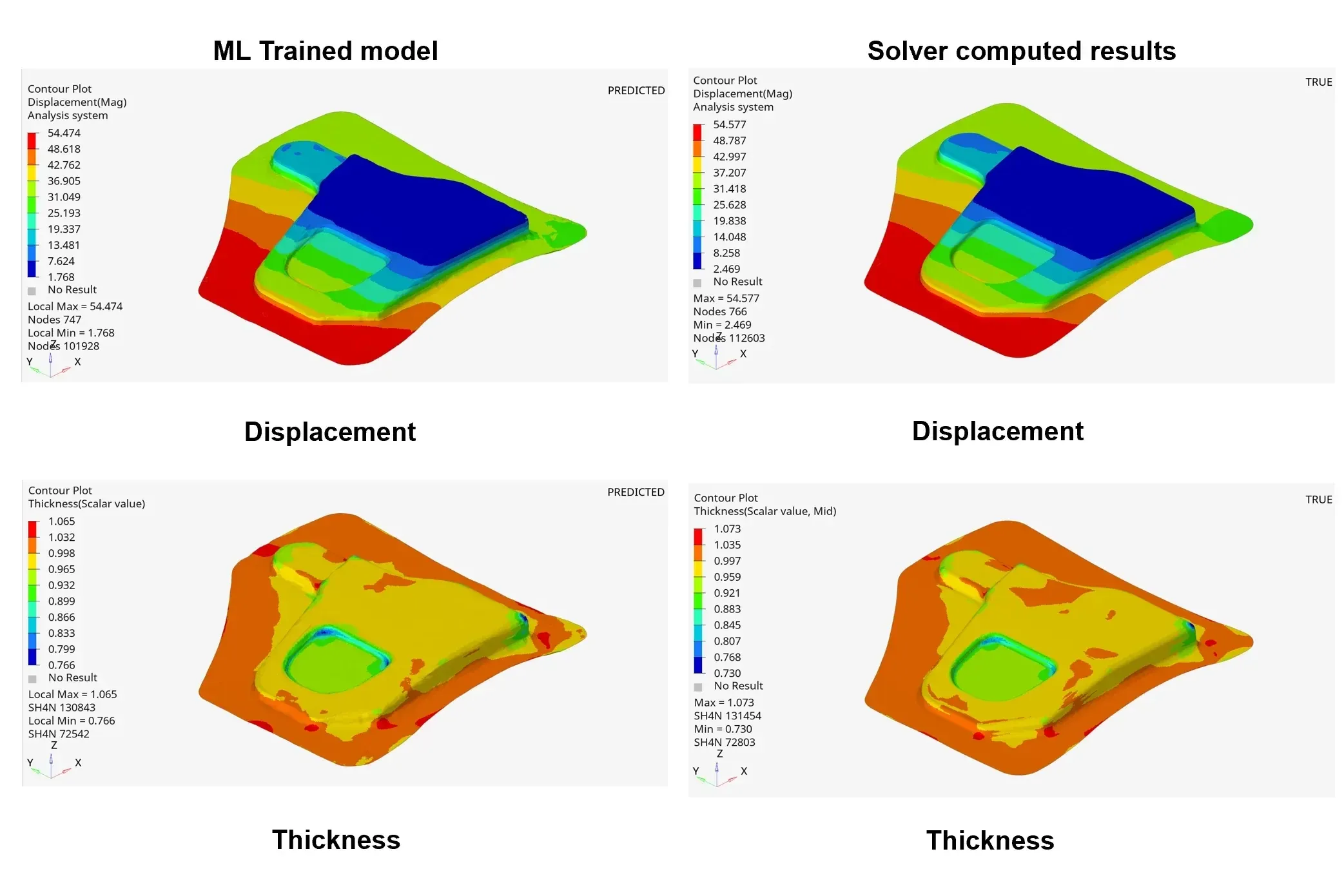 PhysicsAI · Trained Model vs Solver
Multiphysics Predictions
Predictions for Structural, Thermal, Fluid and EM Problems
PhysicsAI is not limited to one physics domain. The same geometric deep learning approach predicts displacement on a wing, temperature in an electronics enclosure or pressure in an HVAC duct, so structural, thermal, CFD and electromagnetic teams can each put their own results to work.
Predictions cover single performance values, surface fields and full 3D volume fields. Loads, materials and boundary conditions can be part of the training data too: if they vary between samples, PhysicsAI can learn their influence.
- Global Values Such as Drag and Lift Coefficients
- Surface Fields Such as Pressure and Wall Shear Stress
- Full 3D Volume Fields
- Loads, Materials and Boundary Conditions That Vary Between Samples
 Electronics Enclosure · Temperature
Siemens lists automotive uses that include crash, durability, aerodynamics, electromagnetic and manufacturing analysis across interior, exterior and powertrain components.
Trust and Validation
Predict With Confidence, Then Validate With the Solver
A prediction is only useful if you know when to trust it. PhysicsAI is trained on validated simulation data, and each model can be checked against known results with error metrics such as mean absolute error before anyone makes a decision with it.
A built-in geometric similarity score, based on geometry and discretization, shows how similar a new design is to the training dataset. Designs inside the trained space get fast predictions; out-of-distribution designs are flagged for a full-fidelity run. PhysicsAI complements traditional solvers, which remain the reference for final validation and certification.
- Test Models Against Results They Have Not Seen
- Accuracy Metrics Such as Mean Absolute Error
- Geometric Similarity Score for Every New Design
- Full Solver Runs for Final Validation
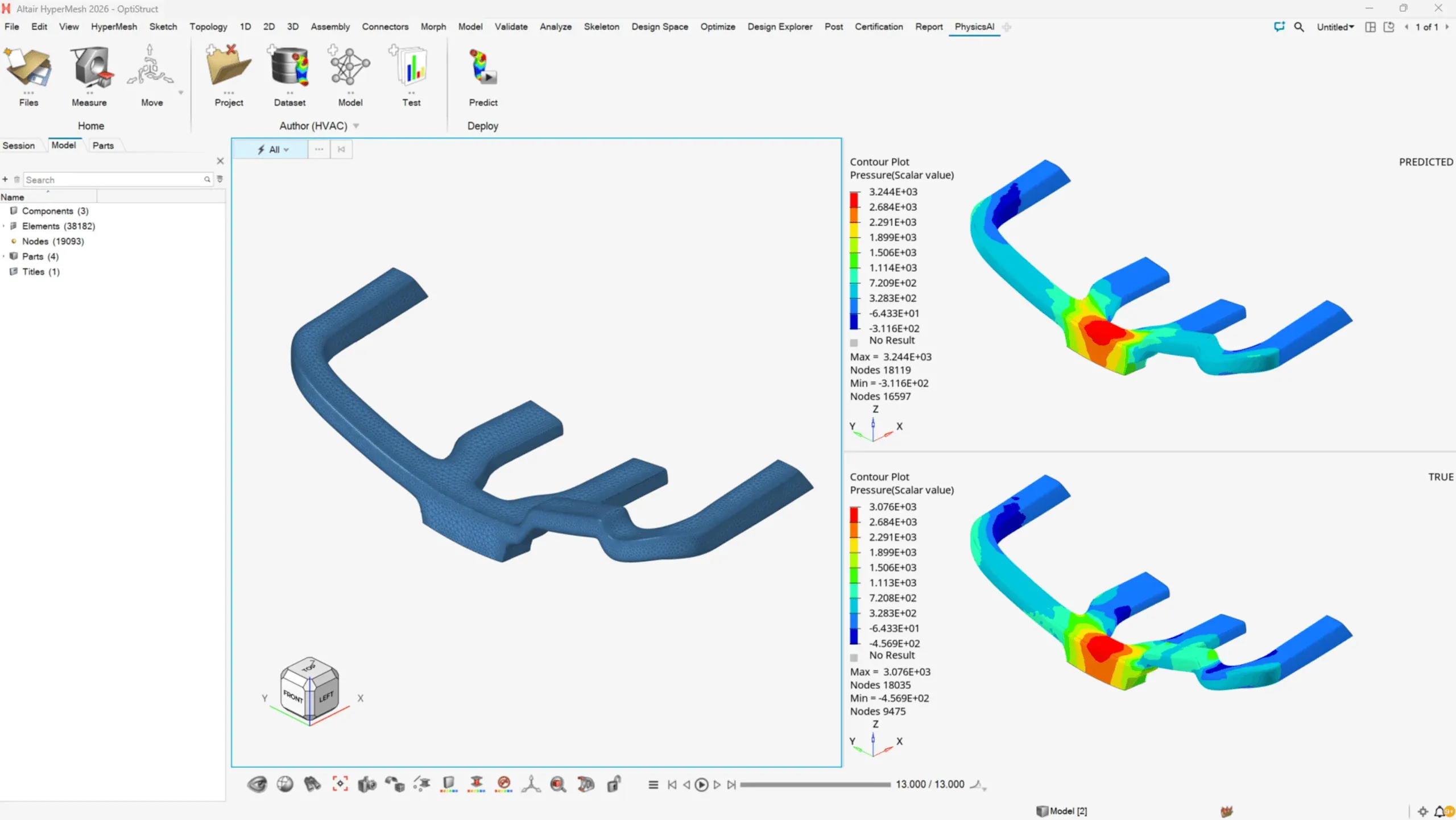 HVAC Duct · Pressure Prediction
Comparison
PhysicsAI vs Traditional Surrogate Models
Response surfaces and other parametric surrogate models are fast too, but they only know the variables you defined up front. Here is how geometric deep learning differs.
| Consideration | Altair PhysicsAI | Parametric Surrogate Models |
|---|---|---|
| What It Learns From | The geometry itself, as CAD or mesh, together with its simulation results | A predefined set of design variables and the responses at sampled points |
| Design Freedom | New shapes and topologies, including non-parametric designs | Variations within the parameters and ranges you set up |
| Outputs | Single values, surface fields and full 3D field results | Simple outputs such as single performance values |
| Setup Effort | No manual feature engineering; reuses past results across designs and programs | Variables are parameterized first, then sampled with a design of experiments |
| Trust Check | Geometric similarity score flags out-of-distribution designs | Valid inside the sampled parameter ranges |
| Best Fit | Exploring new shapes early with results you already have | Tuning a few well-defined variables on a fixed design, for example in HyperStudy |
Simcenter STAR-CCM+
PhysicsAI in Simcenter STAR-CCM+ Design Manager
Siemens has embedded PhysicsAI in Design Manager in Simcenter STAR-CCM+, so CFD engineers train, validate and predict in one familiar interface. It handles polyhedral meshes natively and can learn from historical CFD results, including results from legacy solvers and earlier design-of-experiments studies.
- Native Polyhedral Mesh Support
- Training on Historical and Legacy-Solver CFD Results
- Manual, Sweep, Smart Sweep and Optimization Studies
- Global, Surface and Volume Field Predictions
Siemens cites predictions up to 100x faster on GPU than on CPU. Read our take on Simcenter PhysicsAI in STAR-CCM+ or explore Simcenter STAR-CCM+.
Customer Example
Near-Instant Packaging Predictions at Kinetic Vision
In a customer story published by Siemens, Kinetic Vision adopted Simcenter PhysicsAI to transform packaging design, replacing weeks of simulation with near-instant AI predictions.
Results depend on the problem and on the quality and quantity of training data, so the best test is a model trained on your own simulation history. We can help you pick a first use case and prepare the data.
- Up to 4,000x Faster Than Traditional FEA
- Up to 97.5% Accuracy
- Weeks of Simulation Replaced by Near-Instant Predictions
- Savings in the Millions of Dollars
- Less Plastic Waste Reaching Landfills
Results reported by Siemens for Kinetic Vision’s packaging designs.
Licensing & Pricing
PhysicsAI Price and Altair Units Licensing
PhysicsAI is not sold as a fixed-price, single-product seat. In HyperWorks it is licensed through Altair Units, a pooled subscription that also runs HyperMesh, OptiStruct, SimLab, Inspire and the rest of the Altair portfolio.
Your PhysicsAI cost depends on how many engineers train and predict at the same time and which other applications draw from the same pool. We size a proposal from your workflows instead of quoting a list price. Working in STAR-CCM+? There PhysicsAI is an add-on to your Simcenter STAR-CCM+ license.
- Annual Subscription Sized to Your Concurrent Users
- The Same Units Also Run HyperMesh, OptiStruct and SimLab
- Startup, Academic and Competitive-Replacement Programs Available
- Installation, License Server Setup and Onboarding Included
Browse the full Altair software portfolio, read more about Altair licensing and support or see how engineering software pricing works across Altair and Siemens.
Get PhysicsAI Pricing
Tell us what you want to predict and which tools you use. We’ll size an Altair Units proposal.
Thanks, Your Request Is In
An application engineer will follow up with next steps.
Training & Services
PhysicsAI Onboarding, Training and Engineering Support
TrueInsight provides PhysicsAI licensing and expert support to help engineering teams turn existing simulation data into predictive models, from onboarding and data preparation to model training and validation.
We help your team choose datasets that represent the designs you want to predict, read the error metrics and decide when a prediction is good enough and when the solver should have the last word. Need the simulations behind the model? Our FEA consulting and training services can run them.
- Preparing Training and Test Datasets From Past Results
- Training, Testing and Validating Models
- Deciding When to Trust a Prediction and When to Re-Solve
Guides and Articles
- Step-by-Step Walkthrough: Using Altair PhysicsAIBuild datasets, train a model and test it in HyperMesh.
- Simcenter PhysicsAI Comes to STAR-CCM+Geometric deep learning for CFD design exploration.
- FEA vs CFD: What’s the Difference?Which analysis your training data comes from.
- Structural Analysis SoftwareEvery Altair structural tool in one place.
From the Blog
Latest From the Engineering Blog
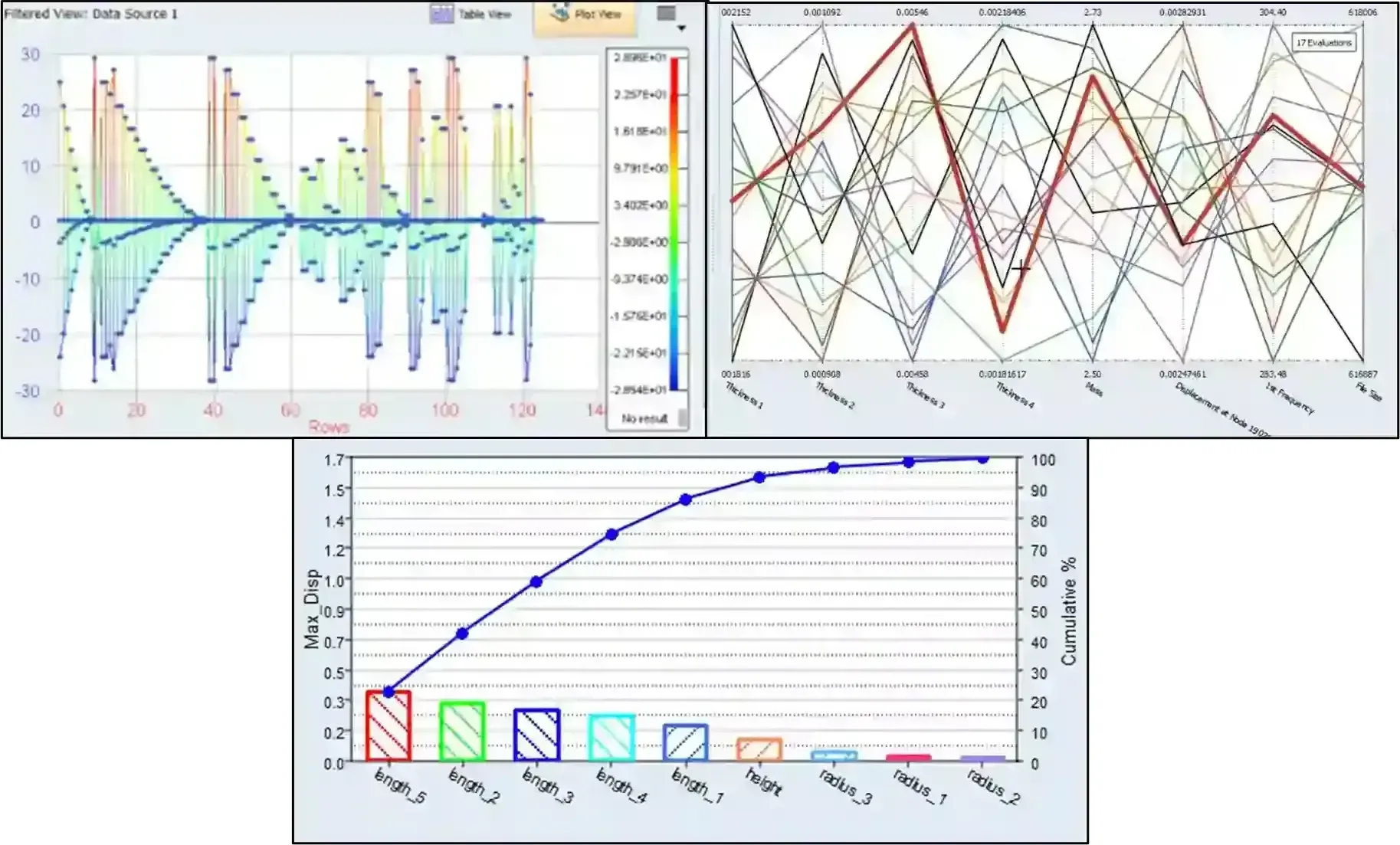
Leveraging Simcenter HyperStudy & PSIM Part 2: From Integration to Optimization
Check out part 2 in this series, where we take the coupled PSIM and HyperStudy model from DOE to optimization.
Read Article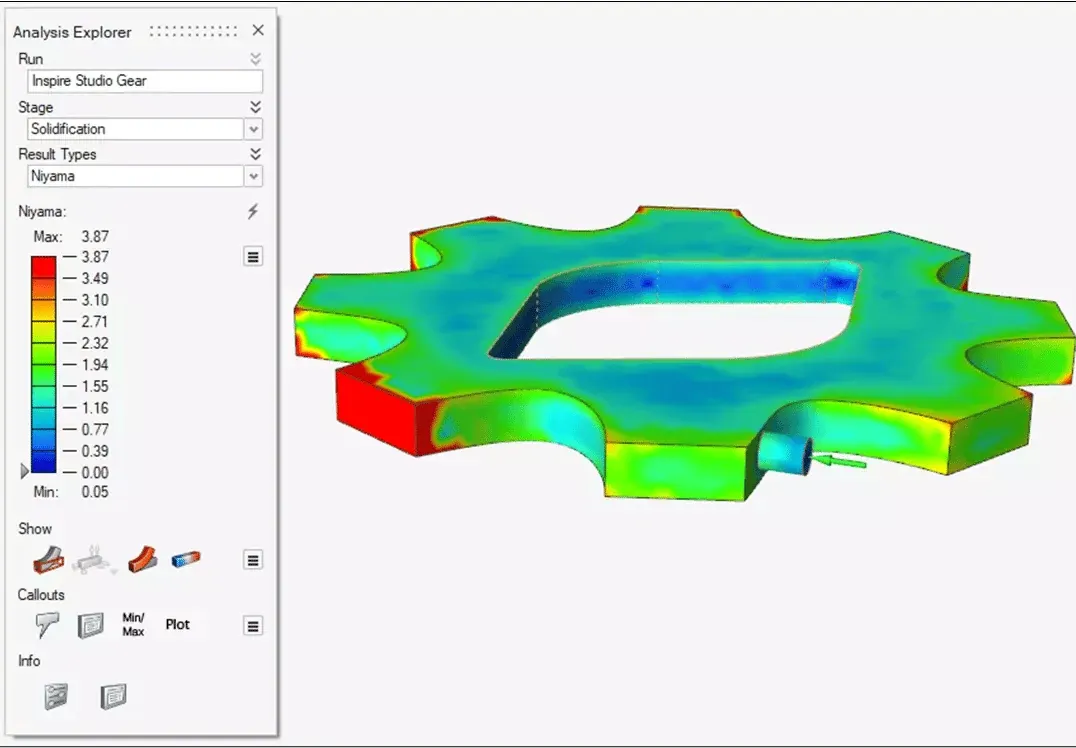
What’s New in Inspire 2026.1: Optimizing With a Porosity Constraint From Inspire Cast
New to Simcenter Inspire 2026.1 users can now factor casting porosity within a topology optimization study.
Read Article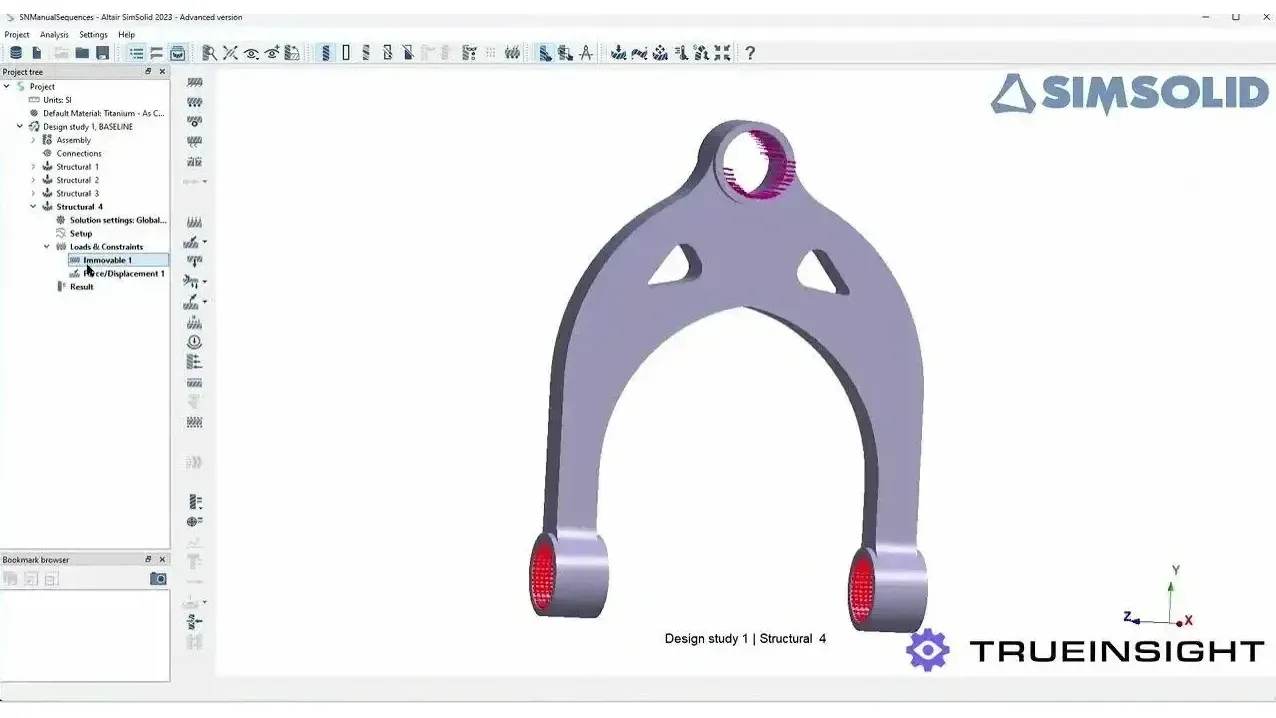
SimSolid vs HyperMesh and OptiStruct: When You Actually Need a Mesh
When meshless SimSolid is enough, and when HyperMesh and OptiStruct earn their time. A practical decision guide with real acceptance criteria.
Read ArticleFAQ
Frequently Asked Questions About Altair PhysicsAI
What Is Altair PhysicsAI Used For?
PhysicsAI predicts simulation results for new designs from the simulations you have already run. Engineers use it for early-stage design exploration and rapid iteration: screening many concepts in seconds, then sending only the most promising ones to a full solver run.
How Is PhysicsAI Different From Traditional Parametric Studies?
Parametric studies and conventional surrogate models work on a predefined set of design variables, so they only cover the variations you parameterized. PhysicsAI applies geometric deep learning to the CAD or mesh geometry itself, so it can learn from different designs and programs and explore a broader design space, with full 3D field results instead of only single values.
What Types of Models Can PhysicsAI Work With?
Both CAD geometry and mesh-based models. PhysicsAI learns from existing simulation datasets across different designs, components and programs, and Siemens describes it as solver-agnostic, so native CAE models and legacy results can be used without reformatting. In Simcenter STAR-CCM+ it also handles polyhedral meshes natively.
How Do I Know If a PhysicsAI Prediction Is Reliable?
Train on validated simulation data, then test the model against results it has not seen using error metrics such as mean absolute error. A built-in geometric similarity score shows how close a new design is to the training data and flags out-of-distribution designs that need a full solver run. Confirm the final candidates with the solver.
Is PhysicsAI Only for One Physics Domain?
No. PhysicsAI supports structural, thermal, fluid and electromagnetic simulations, so the same approach can be applied to many types of engineering problems.
Do I Still Need Traditional Simulations With PhysicsAI?
Yes. PhysicsAI complements traditional solvers rather than replacing them. It is ideal for early-stage exploration and rapid iteration, while full simulations remain the reference for critical designs, final validation and certification.
How Many Simulation Results Do I Need to Train a Model?
It depends on the complexity of the problem. Some cases produce reliable predictions from only a few examples, while many need dozens or even hundreds. Siemens suggests starting to evaluate model quality once you have at least 10 representative result files.
Does PhysicsAI Require a GPU?
No, but a GPU is highly recommended for faster training. CPU-based training is supported, large-scale training can use high-performance computing, and training and inference can run locally, in the cloud or on secure on-premises servers, so your design data stays in an environment you control.
Is PhysicsAI Now Simcenter PhysicsAI?
Yes. Siemens acquired Altair, and with the June 2026 Simcenter release former Altair products joined the Simcenter family, so PhysicsAI also carries the Simcenter PhysicsAI name. It is available in HyperMesh, SimLab and Inspire, and as an add-on in Simcenter STAR-CCM+. TrueInsight licenses and supports it under either name.
How Much Does PhysicsAI Cost?
In HyperWorks, PhysicsAI is licensed through Altair Units, so there is no fixed per-seat list price. The cost depends on how many engineers use it at the same time and which other Altair applications share the pool. Request PhysicsAI pricing and we’ll size a proposal to your team.
Related Pages
More Altair Simulation Software
Altair HyperWorksThe CAE platform that includes PhysicsAIGet Started
Ready to Put Your Simulation Data to Work With PhysicsAI?
Whether you’re evaluating PhysicsAI for the first time or planning a model on your own results, our engineers will help you get predictions you can trust.
- Authorized Siemens & Altair Partner
- Expert Engineering Support
- Licensing Sized to Your Team