Altair Radioss · Explicit Dynamics
Altair Radioss Explicit Crash Simulation
The explicit solver for crash, drop, impact, blast and ballistic events that unfold in milliseconds, with large deformation, complex contact and material failure. Now part of Siemens as Simcenter Radioss, licensed and supported by TrueInsight.
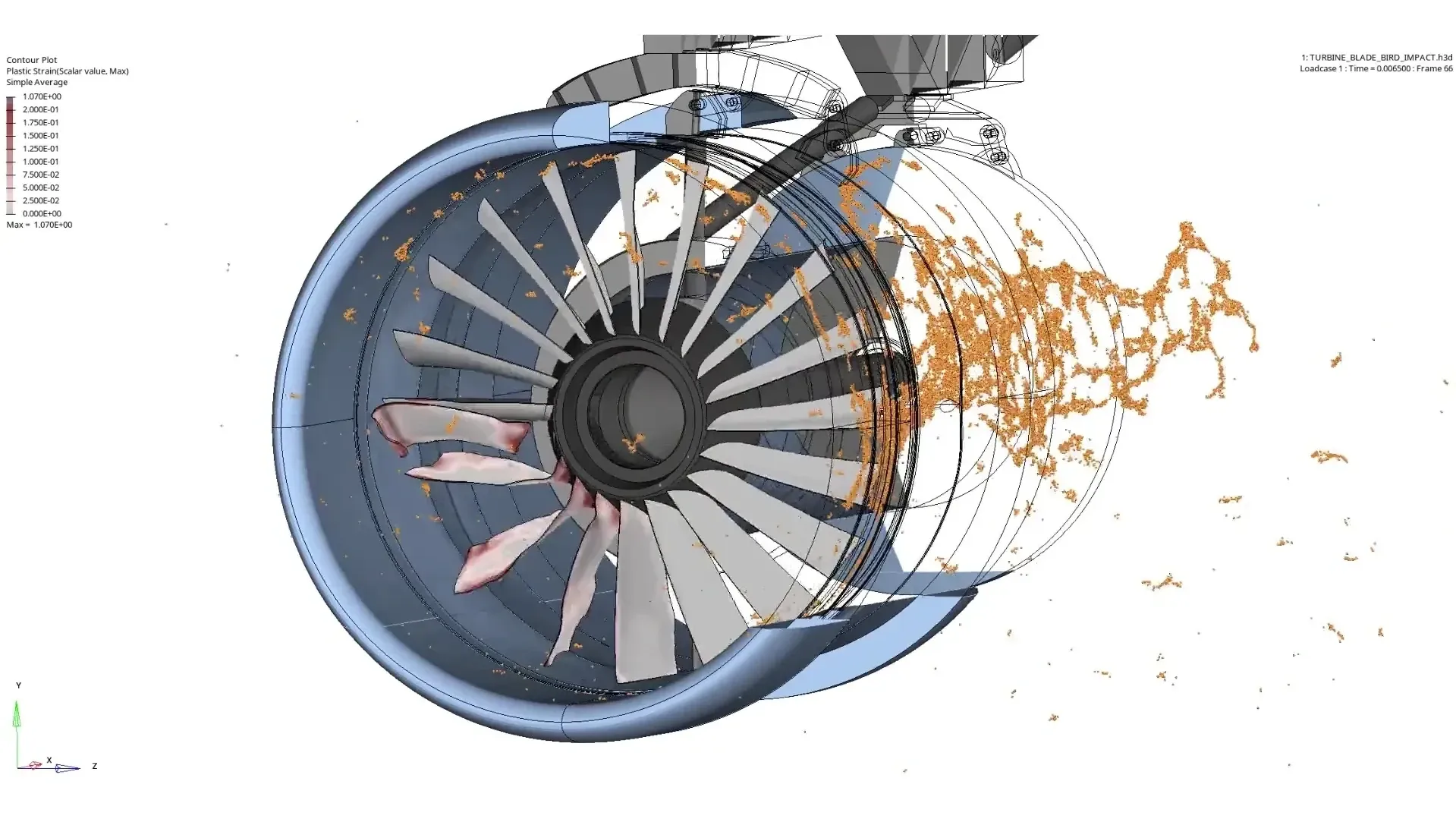 Radioss · Bird Strike
Overview
What Is Altair Radioss?
Altair Radioss is an explicit dynamics solver for highly nonlinear scenarios. It simulates how complex systems respond to dynamic loading, such as crash, impact, drop tests, blast and ballistics, as well as manufacturing and assembly processes, product misuse and accidental component failure, capturing large deformation, complex contact and material failure as they happen.
Radioss is part of the Altair HyperWorks platform, and HyperMesh prepares Radioss models natively. With the June 2026 Simcenter release, former Altair products joined the Siemens Simcenter family, so Radioss now also carries the Simcenter Radioss name. TrueInsight licenses and supports it under either name.
- Crash, Drop, Impact, Blast and Ballistic Events
- Large Deformation, Complex Contact and Material Failure
- Runs LS-DYNA Input Decks Directly
- Scales Across Computing Architectures for Large Models
 Solar Panel · Hail Impact
Key Capabilities
Explicit Dynamics for Crash, Impact and Extreme Events
Radioss is designed for scenarios where linear methods are not sufficient: violent, short-duration events with large deformation, complex contact and material failure, at the scale full-system models need.
Crashworthiness and Safety
Full-system crash and safety simulation with large deformation, complex contact and nonlinear materials, to predict structural behavior and improve safety performance before physical testing.
Impact and Drop Events
Check how a product survives drops, knocks and misuse before the first physical test, then test fewer prototypes.
Blast and Ballistic Analysis
Simulate blast pressure and projectile strikes on panels, enclosures and armor, load cases that are costly or unsafe to test.
ALE and SPH Interaction Modeling
Arbitrary Lagrangian-Eulerian (ALE) and smoothed particle hydrodynamics (SPH) methods model fluid-structure and other highly dynamic interactions beyond standard contact.
Advanced Material and Damage Models
State-of-the-art material and damage models for metals and composites under extreme conditions, to design safer, more robust products with confidence.
Scalable Performance for Large Models
Scalability across diverse computing architectures keeps large explicit models fast, and the datasets they generate can train AI models for predictive insights.
Crash and Safety
Full-Vehicle Crash, Rollover and Occupant Safety
Radioss is built for crash and safety scenarios such as full-vehicle crash, high-speed impacts and vehicle rollovers. Partner tools add crash dummies and human body models (HBM) for extensive safety evaluation, so occupant protection can be assessed alongside the structure.
For the shift toward electrification, dedicated material and failure models support detailed analysis of applications like battery systems for electric vehicles and urban air mobility concepts. Radioss can even model the human head with tissues, bones and muscles: see simulating the impact of a Mike Tyson punch.
- Full-Vehicle Crash, High-Speed Impact and Rollover
- Crash Dummies and Human Body Models via Partner Tools
- Material and Failure Models for EV Battery Systems
 Head and Neck · Impact Model
Drop and Impact
Drop Tests, Impact and Product Misuse
Radioss simulates high-speed impact and drop events with precise contact handling and energy transfer, so engineers can evaluate intrusion, peak loads and structural response over time. The same explicit approach covers product misuse, accidental component failure and manufacturing and assembly processes.
For manufacturing simulation such as blow molding, Radioss Advanced Mass Scaling (AMS) reduces computation time significantly without compromising stress, strain or energy balance.
- Drop and Impact Testing With Precise Contact Handling
- Intrusion, Peak Loads and Response Over Time
- Product Misuse and Accidental Component Failure
- Advanced Mass Scaling for Manufacturing Processes
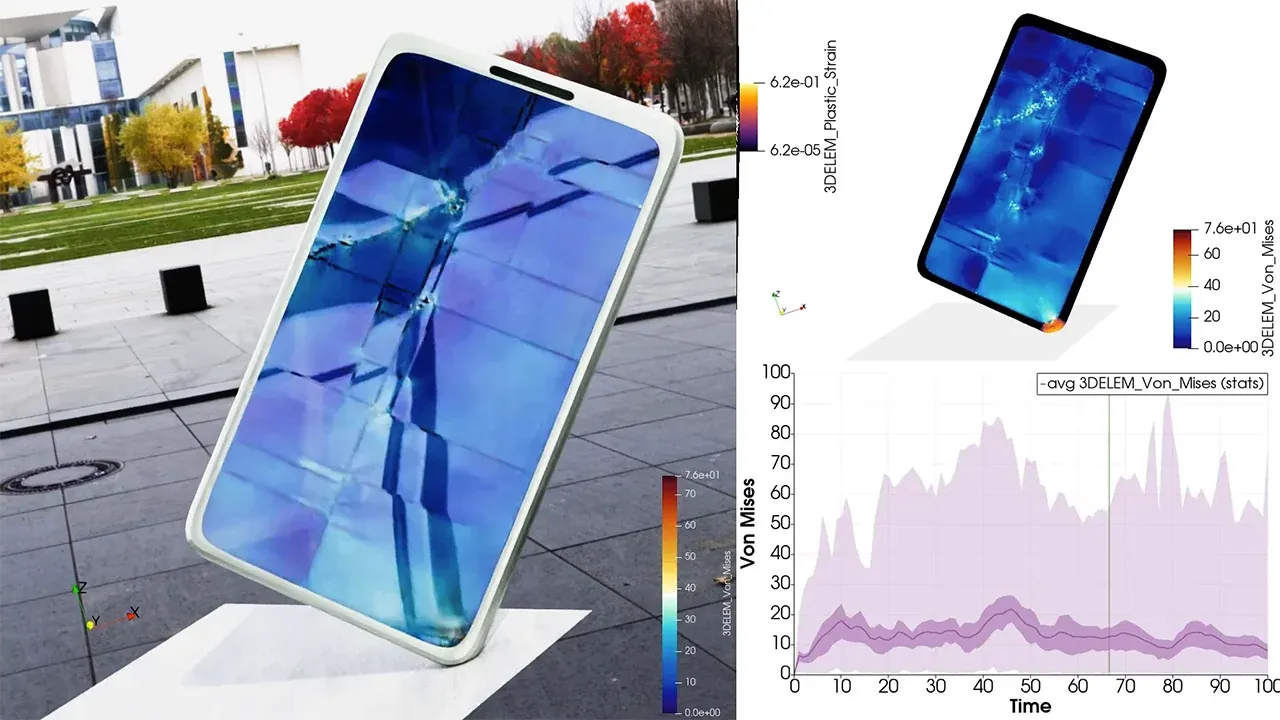 Drop Test · Plastic Strain
Blast and Ballistics
Blast and Ballistic Analysis for Protective Structures
Radioss handles extreme transient load cases such as blast and ballistic events. It supports high strain-rate scenarios, which makes it suitable for designing and validating protective structures under severe dynamic conditions.
Where standard contact is not enough, ALE and SPH methods capture fluid-structure and other highly dynamic interactions, and advanced material models represent metals and composites under extreme loading.
- High Strain-Rate Blast and Ballistic Events
- ALE and SPH for Fluid-Structure Interaction
- Material Models for Metals and Composites
 Ballistic Impact · Pressure
Workflow Integration
Run LS-DYNA Input Decks and Keep Validated Models
Radioss runs external input decks directly, including LS-DYNA input decks within the GUI, while file conversion tools support Abaqus users. Teams can migrate or consolidate explicit workflows without rebuilding models from scratch and keep their prior validation baselines.
- Run LS-DYNA Input Decks Directly in the GUI
- File Conversion Tools for Abaqus Users
- Preserve Prior Validation Baselines
- Benchmarking and Deck Transition Guidance From TrueInsight
Building models from CAD? HyperMesh prepares Radioss models natively, with contacts, rigid bodies, materials, failure and safety models.
Explicit vs Implicit
Explicit or Implicit: Radioss or OptiStruct?
Both solvers run on the same Altair Units license. The right one depends on how fast the load is applied and how long the event lasts.
| Consideration | Radioss (Explicit) | OptiStruct (Implicit) |
|---|---|---|
| Best For | Highly nonlinear, transient dynamic events that last a short time, such as crash, impact, drop, blast and ballistics | Static and long-duration, low-speed events, plus NVH, fatigue and structural optimization in OptiStruct |
| Typical Physics | Large deformation, complex contact, material failure and ALE or SPH interactions | Linear and nonlinear statics with contact, bolts and gaskets, normal modes, frequency response and heat transfer |
| Static Loads | Quasi-static loading with dynamic relaxation (/DYREL) or kinetic relaxation (/KEREL) | Linear and nonlinear static analysis |
| Model Input | Radioss models, or LS-DYNA input decks run directly | Finite element models from HyperMesh or other pre-processors |
| Licensing | Altair Units | Altair Units, from the same pool |
Customer Success
Radioss Users in Action
How engineering teams have used Radioss for rollover protection, vehicle safety and crash simulation at scale.
IDES: Rollover Protection for a Defense Vehicle
Australian engineering firm IDES used Radioss to design a rollover protection structure (ROPS) for the Army’s G-Wagon. Simulating the pendulum crash tests virtually replaced costly physical prototypes and kept delivery within strict project deadlines.
Arcimoto: Safe Three-Wheeled Electric Vehicle
Arcimoto used Radioss to develop its electric three-wheeled Fun Utility Vehicle (FUV), validating roof crush, roll cage and structural performance through simulation while keeping costs down as a startup.
NIAR: Crash Simulation Scalability on Cloud HPC
The National Institute for Aviation Research (NIAR) demonstrated Radioss scalability with multi-domain crash simulations on cloud infrastructure, with consistent results across large-scale HPC runs.
Licensing & Pricing
Radioss Price and Altair Units Licensing
TrueInsight licenses Radioss through Altair Units, a pooled subscription that also runs HyperMesh, OptiStruct, SimSolid, Inspire and the rest of the Altair portfolio, so there is no fixed per-seat list price.
Your Radioss cost depends on how many analysts solve at the same time, the size of your explicit runs and which other applications draw from the same pool. We size a proposal from your workflows instead of quoting a list price.
- Annual Subscription Sized to Your Concurrent Users
- The Same Units Also Run HyperMesh, OptiStruct and SimSolid
- Startup, Academic and Competitive-Replacement Programs Available
- Installation, License Server Setup and Onboarding Included
Read more about Altair licensing and support or how engineering software pricing works across Altair and Siemens.
Get Radioss Pricing
Tell us which events you simulate and how many engineers solve. We’ll size an Altair Units proposal.
Thanks, Your Request Is In
An application engineer will follow up with next steps.
Training & Services
Radioss Training and Engineering Support
TrueInsight goes beyond Radioss licenses. Our application engineers support onboarding, workflow setup, model review and practical best practices for explicit crash and impact simulation.
From initial setup to advanced troubleshooting, we help your team reduce errors, improve model quality and deliver accurate simulations faster. Migrating from another solver? Benchmarking and deck transition guidance keep your results consistent and defensible. Need the analysis done for you? Our FEA consulting and training services can run the study.
- Onboarding and Explicit Workflow Setup
- Model Review and Advanced Troubleshooting
- Benchmarking and Deck Transition From Other Solvers
Guides and Articles
- Simulating the Impact of a Mike Tyson PunchHook, jab and uppercut on a detailed head model.
- Altair HyperMeshBuild and set up Radioss models.
- FEA vs CFD: What’s the Difference?Which analysis your problem needs.
- Structural Analysis SoftwareEvery Altair structural tool in one place.
FAQ
Frequently Asked Questions About Altair Radioss
What Is Altair Radioss Used For?
Radioss is used for explicit dynamics simulation, especially crash, impact, drop tests, blast and ballistic events, where large deformation, complex contact and failure happen in milliseconds and must be captured realistically. It also covers manufacturing and assembly processes, product misuse and accidental component failure.
Is Radioss Crash Simulation Software or a Solver?
Radioss is the explicit dynamics solver behind many crash and impact workflows. Teams often call it crash simulation software because it is the engine running the physics for crashworthiness and safety studies, with models typically built in HyperMesh.
When Should I Choose Radioss Over an Implicit Solver?
Choose Radioss when the event is highly nonlinear, transient and short: severe deformation, large contact interactions, material failure or high-speed impact. Implicit solvers such as OptiStruct are better for static or long-duration, low-speed events.
Can Radioss Run Static Analysis?
Yes, by using quasi-static loading and special options such as dynamic relaxation (/DYREL) or kinetic relaxation (/KEREL). For purely static or slowly evolving problems, an implicit solver is usually the better fit.
Can We Reuse Existing Models or LS-DYNA Input Decks?
Often, yes. Radioss runs LS-DYNA input decks directly within the GUI, and file conversion tools support Abaqus users. Reusing decks reduces switching friction and preserves prior validation baselines; the right approach depends on your current deck type and modeling conventions.
What Is OpenRadioss, and How Is It Different?
OpenRadioss is the open-source version of the Radioss solver. Teams typically evaluate it when they want openness and portability, while commercial Radioss is commonly chosen for production programs that prioritize enterprise-grade deployment, support and integrated workflows.
Separately, the Radioss Research & Development Program is a managed shared-source environment where academic and industrial partners co-innovate on the future of explicit dynamics.
Is Radioss Part of HyperWorks?
Yes. Radioss is the explicit solver of Altair HyperWorks, alongside HyperMesh, OptiStruct, SimSolid and HyperStudy. All of them run on the same Altair Units license.
Is Radioss Now Simcenter Radioss?
Yes. Siemens acquired Altair, and with the June 2026 Simcenter release former Altair products joined the Simcenter family, so Radioss also carries the Simcenter Radioss name. It is the same explicit solver, and TrueInsight licenses and supports it under either name.
How Much Does Radioss Cost?
Radioss is licensed through Altair Units, so there is no fixed per-seat list price. The cost depends on how many engineers solve at the same time, the size of your explicit runs and which other Altair applications share the pool. Request Radioss pricing and we’ll size a proposal to your team.
How Does TrueInsight Help Beyond Licensing?
We help you get value fast: onboarding, workflow setup, model review and practical best practices for explicit crash and impact simulation. If you’re migrating from another solver, we reduce risk with benchmarking and deck transition guidance, so your results stay consistent and defensible.
Related Pages
More Altair Structural Simulation Software
Altair HyperWorksThe CAE platform that includes RadiossGet Started
Ready to Take the Next Step With Radioss?
Whether you’re evaluating Radioss for the first time or moving crash workflows from another solver, our engineers will help you get reliable results quickly.
- Authorized Siemens & Altair Partner
- Expert Engineering Support
- Licensing Sized to Your Team